
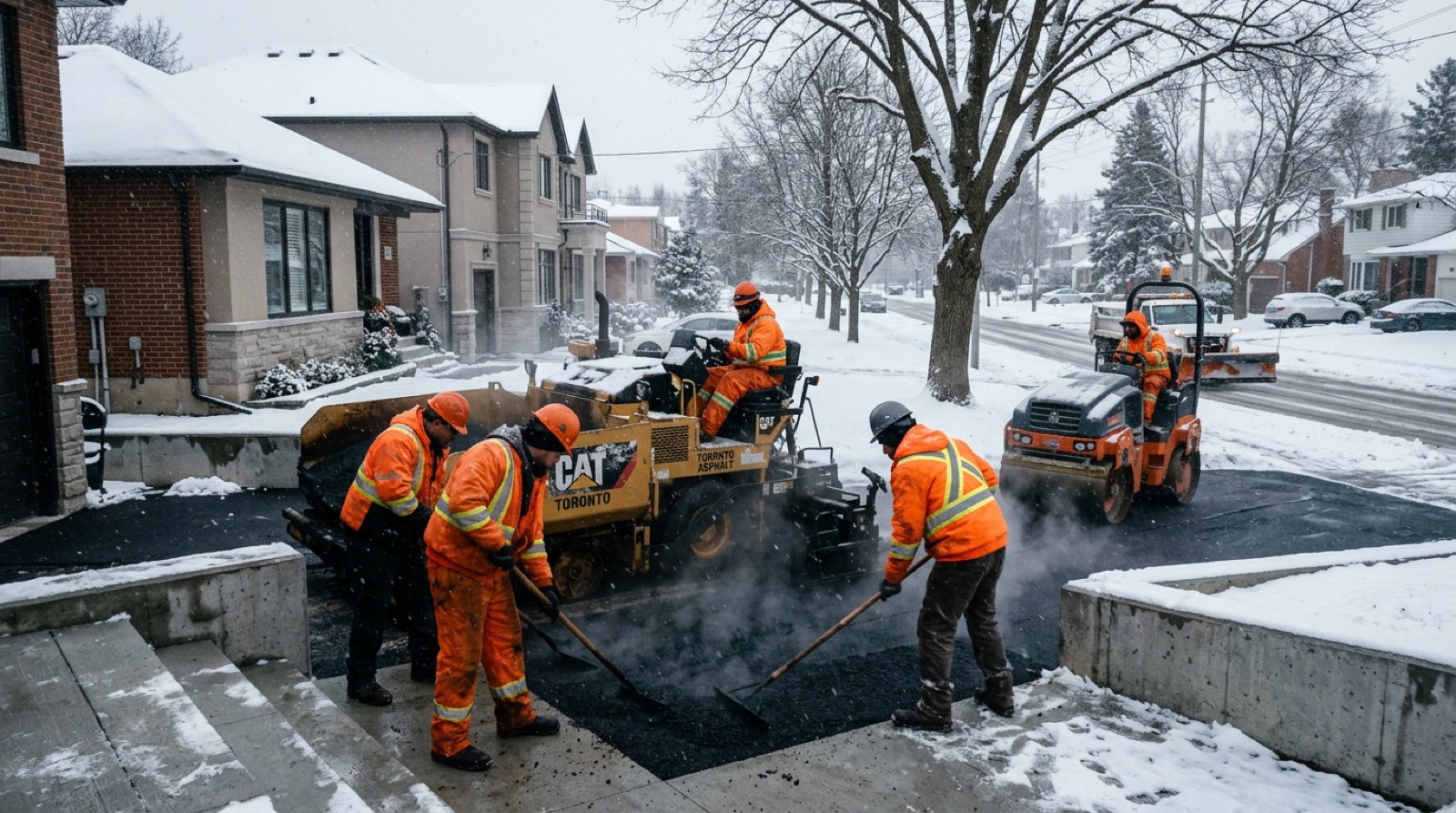
For most Toronto homes, asphalt is the better winter driveway. It flexes with freeze-thaw movement instead of cracking apart, costs roughly half as much to install, and repairs are cheaper and far less visible.
Concrete still wins on lifespan and on a certain clean look. The trade is that when Ontario winters do damage it, the fixes are expensive and permanent-looking.
How Each Material Handles Freeze-Thaw
Toronto sits in a nasty climate zone for paving. Environment Canada data puts the city near 100 freeze-thaw cycles a year, and the lakefront humidity means there is almost always moisture available to get into the surface.
Water seeps into small openings, freezes, expands about nine percent, and pries the opening wider. Repeat that a hundred times a winter and small defects become potholes.
Asphalt: flexible, so it moves instead of breaking
Asphalt is a flexible pavement. The bitumen binder lets the surface shift slightly as the ground below heaves and settles.
That flexibility is why asphalt driveways in older Toronto neighbourhoods like Etobicoke and Scarborough tend to develop hairline cracks rather than blown-out sections. Those cracks are cheap to deal with if you catch them, which is the whole logic behind sealing cracks and joints before winter arrives.
Concrete: rigid, so stress has to go somewhere
Concrete is a rigid pavement. When frost heave pushes a slab up unevenly, the slab cannot flex, so it cracks or the joints spall.
Road salt makes it worse. Chloride attacks the concrete surface directly, causing the pitted, flaking texture you see on Ontario garage aprons after five or six winters.
De-icing salt does not chemically attack asphalt the same way. That single difference matters a lot in a city where salt trucks run all winter.
Cost to Install in Toronto
Asphalt is consistently the cheaper install, usually by a wide margin. Exact numbers depend on driveway size, access, and how much excavation the base needs.
| Factor | Asphalt | Concrete |
|---|---|---|
| Typical Toronto install cost | $7 to $13 per sq ft | $14 to $25 per sq ft |
| Usable after paving | 2 to 3 days | 7 days minimum, 28 for full cure |
| Best install season | May to October | May to September |
Cure time is not a small detail in Ontario. A concrete pour late in the season can be compromised by an early cold snap, while asphalt only needs the ground and air warm enough to compact properly.
We break the numbers down further in our guide to what an asphalt driveway costs in Toronto.
Repair Cost and Difficulty
This is where the gap gets widest, and it is the part most homeowners underestimate.
Asphalt repairs blend in. A crack gets filled, a pothole gets cut out and patched, and within a season the colour evens out.
- Asphalt crack repair: a few hundred dollars, done in a morning
- Asphalt pothole patch: low cost, and the patched area bonds to the surrounding surface
- Asphalt resurfacing: a new top layer over a sound base, roughly a third the cost of full replacement
- Concrete crack repair: visible for the life of the slab, no matter how good the fill
- Concrete slab replacement: often the only real fix, and it means removing and repouring a whole section
There is no concrete equivalent to laying a fresh overlay on a driveway that is tired but structurally fine. With concrete, you either live with the damage or you demolish and pour again.
Lifespan in Ontario Conditions
Concrete lasts longer on paper. A well-poured Toronto driveway can run 30 years or more, while asphalt typically gives 15 to 25.
Maintenance changes those numbers more than the material does. An asphalt driveway that gets sealed every three or four years and has its cracks filled each fall will comfortably outlive a neglected concrete slab that spends every winter absorbing salt.
The other variable is what is underneath. Most Ontario driveway failures trace back to the base, not the surface, which is why proper grading and a compacted granular base does more for lifespan than any material choice.
What actually kills a Toronto driveway
- Water pooling because the slope was never set correctly
- A thin or poorly compacted base over clay soil
- Unsealed cracks that let meltwater reach the base
- Tree roots, especially on older lots with mature maples
Resale Value
Toronto buyers respond to a driveway that looks maintained far more than to the material it is made from. A freshly sealed black asphalt driveway shows better than cracked, salt-scaled concrete every time.
Real estate agents across the GTA generally treat a fresh driveway as a cost-recovery item rather than a value-add. You get most of your money back, and more importantly you remove an objection during showings.
Given asphalt costs roughly half as much, the return per dollar spent favours asphalt clearly. Concrete only pulls ahead in higher-end areas where a stamped or exposed aggregate finish matches the architecture.
When Concrete Is the Right Call
Concrete makes sense for a heated garage apron, for a decorative finish you specifically want, or where heavy vehicles park in one spot all day.
It also holds up better in shaded areas that stay damp, since asphalt can soften slightly under sustained summer heat in full sun. For most residential lots in Toronto, neither factor outweighs the cost and repair advantages.
The Practical Answer for Most Toronto Homes
Choose asphalt if you want lower upfront cost, faster installation, cheap repairs, and a surface that tolerates salt and frost movement. Choose concrete if maximum lifespan and a specific decorative look matter more than budget.
Either way, budget for maintenance. On asphalt that means a sealcoat every few years and crack filling each autumn before the first hard freeze.
If your existing surface is past patching, a full tear out and rebuild resets the base and gives you another two decades. For a straightforward new install, our residential driveway paving work across Toronto covers excavation through final compaction.
Not sure which your driveway needs? Get in touch for a quote and we will assess the base, the drainage, and the damage before recommending anything.