
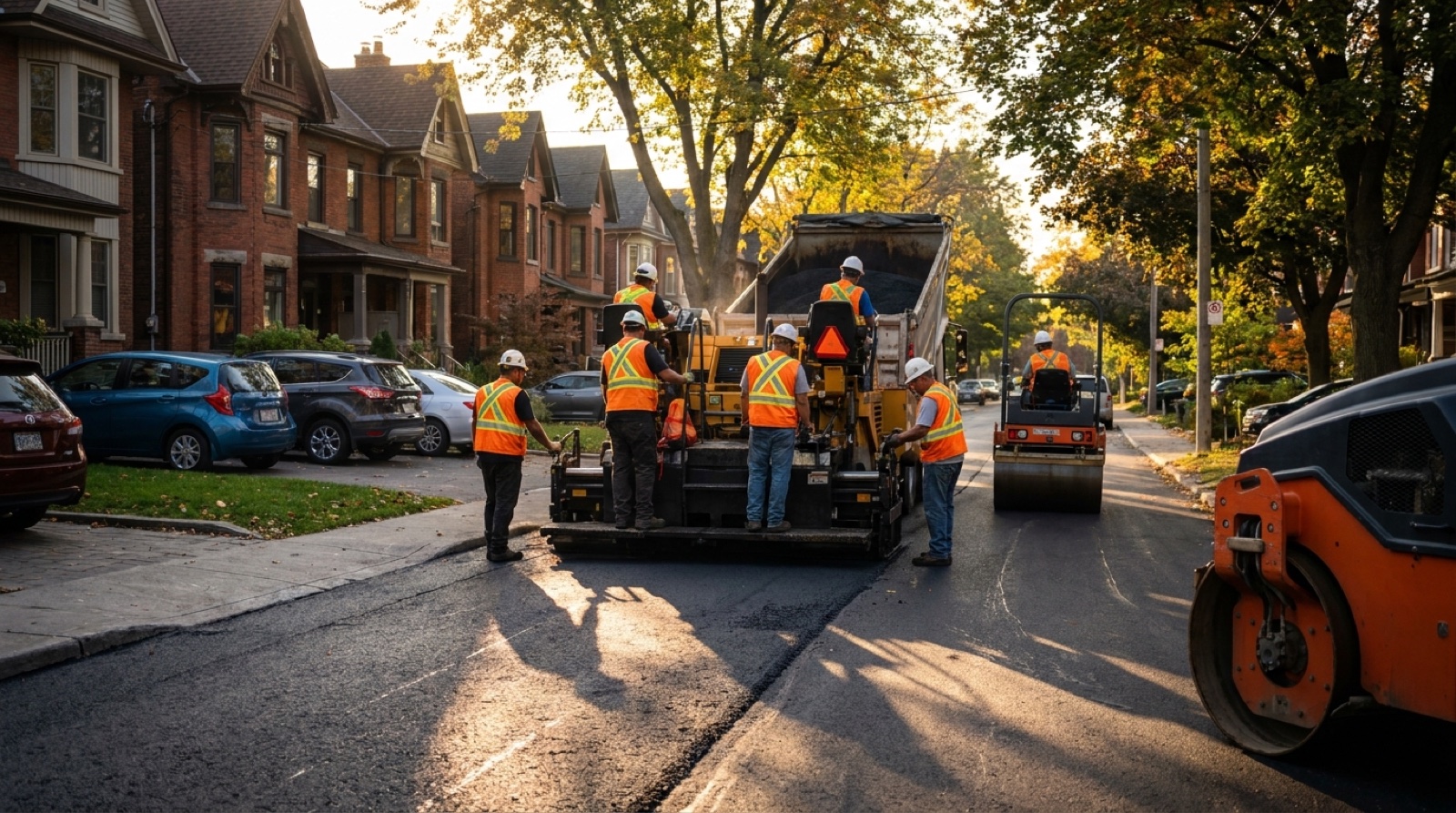
A new asphalt driveway in Toronto typically costs between $7 and $14 per square foot installed. For a standard two car driveway of roughly 600 square feet, that puts most homeowners in the $4,200 to $8,400 range.
Resurfacing an existing driveway that still has a solid base costs less, usually $4 to $7 per square foot. Full removal and replacement sits at the top of the range because the old surface has to come out before anything new goes down.
Toronto Asphalt Driveway Prices by Project Type
The single biggest cost variable is whether you are paving over a sound base or starting from scratch. Here is how the common jobs compare.
| Project Type | Price per Sq Ft | Typical 600 Sq Ft Driveway |
|---|---|---|
| Resurfacing / overlay | $4 to $7 | $2,400 to $4,200 |
| New driveway on prepared ground | $7 to $11 | $4,200 to $6,600 |
| Full removal and replacement | $9 to $14 | $5,400 to $8,400 |
| Sealcoating (maintenance) | $0.35 to $0.70 | $210 to $420 |
These are installed prices covering materials, labour, equipment and disposal. HST is extra.
Very small jobs often carry a minimum charge. A contractor still has to move a paver, a roller and a crew regardless of whether your driveway is 300 square feet or 900.
What Actually Drives the Price Up
Base Condition and Depth
Toronto sits on heavy clay soil through much of the city, and clay holds water. Water that freezes under asphalt lifts it, which is why base depth is not a place to cut corners here.
A residential driveway should have 6 to 8 inches of compacted granular base under 2 to 3 inches of asphalt. Proper excavation, grading and base work can account for a third or more of the total bill, and it is the part that determines whether the driveway lasts eight years or twenty five.
Removing the Old Surface
Tearing out old asphalt adds roughly $1.50 to $3 per square foot. That covers machine time, hauling and tipping fees at the transfer station.
Old concrete or interlock costs more to remove than asphalt because it is heavier and slower to break up. If your existing surface is beyond patching, a full tear out and rebuild is usually the more economical choice over a ten year horizon.
Access and Site Constraints
Narrow lots in areas like Leslieville, the Annex and Riverdale limit what equipment can reach the back of the property. Hand work and smaller machines cost more per square foot than an open suburban lot in Scarborough or Etobicoke.
Steep grades, retaining walls, tree roots and drainage corrections all add labour. So does anything that requires the crew to protect a finished landscape.
Slope and Drainage
Water has to leave the driveway. A minimum slope of about 2 percent away from the house is standard, and achieving it sometimes means extra excavation or adding a catch basin.
Skipping drainage work saves a few hundred dollars now and costs thousands later when the surface cracks and the base washes out.
Line Items to Look for in a Quote
A quote that says nothing but a square foot rate and a total is hard to compare against anything. Ask for the specifics.
- Excavation depth and where the spoil goes
- Granular base type and compacted thickness
- Asphalt thickness after compaction, not before
- Number of lifts and mix type
- Edge treatment and how the driveway meets the garage, walkway and city sidewalk
- Disposal fees and whether they are included
- Warranty length and what it actually covers
Compacted thickness is where lowball quotes hide. Two inches of loose asphalt compacts down to about an inch and a half, which will not survive many Ontario winters under vehicle traffic.
Permits and City Requirements
Work that touches the city boulevard or changes a curb crossing requires approval from the City of Toronto. Widening a driveway or adding a front yard parking pad involves a separate application and its own fees.
Toronto also has rules limiting how much of a front yard can be paved, tied to stormwater management. Confirm this before you commit to a size, because a redesign after the fact is expensive.
When Repair Beats Replacement
Not every tired driveway needs to come out. If the base is stable and the damage is confined to the surface, cheaper options exist.
- Isolated cracks under a quarter inch: sealing the cracks stops water from reaching the base
- Potholes and localised failures: cut and patch repairs handle these for a fraction of replacement cost
- Surface worn but base intact: an overlay adds a new wearing course over the existing one
- Alligator cracking across large areas: the base has failed and replacement is the only real fix
Alligator cracking, the interconnected pattern that looks like scales, is the clear signal. Patching it is throwing money away.
Timing and Seasonal Cost
Paving season in Toronto runs roughly from late April to early November, since asphalt plants close for the winter and cold ground prevents proper compaction. Booking in May or September is easier than trying to squeeze in during the August rush.
Late season work carries some risk. A cold snap in November can force a reschedule, and rushing a job to beat the weather is how compaction problems start.
Protecting the Investment
New asphalt should cure for 6 to 12 months before its first seal. After that, a sealcoat every two to four years slows oxidation and keeps water out of the surface.
Sealing more often than that wastes money and can build up a brittle layer. The bigger gains come from clearing cracks early and keeping drainage clear.
Ready for a real number on your property? Our team handles residential driveway paving across Toronto and the surrounding areas, and larger jobs through our commercial paving division.
Get in touch for a measured, itemised quote with no obligation. We will tell you honestly whether your driveway needs replacing or just repair.